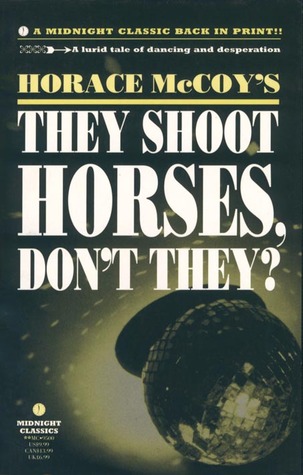
Midnight Classics, as far as I can tell, was an imprint of Serpent’s Tail reserved for publishing forgotten works of pulpy noir and psychedelic fiction. A number of titles were put out in the late 1990s, each boldy declaring that the book was ‘a Midnight Classic back in print’, and all written by authors long forgotten. Names like Gavin Lambert, Stewart Meyer, Rudolph Wurlitzer, and David Goodis. Another was Horace McCoy, probably the best known of the lot.
McCoy’s name has already appeared on booklit where, after a tentative treading of the toes in American noir, with James M. Cain’s The Postman Always Rings Twice, it was suggested in the comments that next up should be McCoy’s They Shoot Horses, Don’t They? (1935). Never one to knock back a recommendation (although always one to never get round to reading it) I bumped it up the list, while all the other titles waiting their turn muttered and cursed under their breath.
With horses in the title, I’d long assumed, wrongly so, that the novel was a western of some description. Instead, the novel’s milieu is quite the reverse of the open range, and a new one on me, the claustrophobic world of the dance marathon. Popular in the 1920s and 1930s, these shindigs brought kids disillusioned by the Depression together to dance, for hours on end, chasing the carrot of prize money dangled before them.
One hundred and forty-four couples entered the marathon dance but sixty-one dropped out for the first week. The rules were you danced for an hour and fifty minutes, then you had a ten-minute rest period in which you could sleep if you wanted to. But in those ten minutes you also had to shave or bathe or get your feet fixed or whatever was necessary.
Although mostly flashbacks, the novel begins in the here and now, by outlining its outcome, that of the sentencing of Robert Syverton for the murder of Gloria Beatty. It’s clear to Syverton that the judge means to make an example of him, especially given that the best line of defense he has is that he was “only doing her a personal favour”:
The Prosecuting Attorney was wrong when he told the jury she died in agony, friendless, alone except for her brutal murderer, out there in that black night on the edge of the Pacific. He was as wrong as a man can be. She did not die in agony. She was relaxed and comfortable and she was smiling. It was the first time I had ever seen her smile. How could she have been in agony then? And she wasn’t friendless.
I was her very best friend. I was her only friend. So how could she have been friendless?
Robert and Gloria have come their separate ways to Hollywood, chasing the same dream. Opportunities, however, are few on the ground, and they enter the marathon dance:
‘Free food and free bed as long as you last and a thousand dollars if you win.’
‘The free food part of it sounds good,’ I said.
‘That’s not the big thing,’ she said. ‘A lot of producers and directors go to those marathon dances. There’s always the chance they might pick you out and give you a part in a picture…What do you say?’
‘Me?’ I said…’Oh, I don’t dance very well…’
‘You don’t have to. All you have to do is keep moving.’
During the dance tempers fray, exhaustion sets in, and the contestents find themselves exploited more and more in the name of entertainment. Robert dreams of being back outside, away from the confines of the ballroom, but in writing the desperate situation of this small dance McCoy holds up a mirror to the America of the time, where life itself is punishing and people try to scrape a living against all the odds. The whole narrative is studied with throwaway lines from Gloria, with nothing to live for, wishing she were dead.
‘It’s peculiar to me,’ she said, ‘that everybody pays so much attention to living and so little to dying. Why are these high-powered scientists always screwing around trying to prolong life instead of finding pleasant ways to end it? There must be a hell of a lot of people in the world like me - who want to die but haven’t got the guts - ‘
Even though we know the outcome, McCoy still manages to build up tension in his story. The continued sapping of the dancers’ will through exploitative tasks and the sheer exhaustion they feel builds up crests of conflict that see the dancers regularly whittled down. To this slow burn plot kindling is added, where chapters are preceded by snippets of the judge’s sentence, each in a typeface a little larger than before, serving well the build up of tension.
Loose on description, heavy on dialogue, the novel sets a fair pace, without being a marathon itself, and when its end comes the death of Gloria is treated unsentimentaly, as befits the hardboiled genre. The ending is powerful, for what it is, and I daresay it’s one that will stick in the mind for a long time to come, but there’s the feeling that there could have been more, that McCoy could perhaps have explored the existentialist nature of his narrator, if even just for a few pages here and there, just to get a little deeper inside Syverton’s head. At the same time, the casual enquiry of the book’s title, in context, carries all the weight needed, and it’s the unanswerable nature of the whydunnit that ensures the book’s durability.
Find out more at: Amazon UK | Amazon US | GoodReads