Gilbert Adair: And Then There Was No One

January 4th, 2009 Stewart

Posted in humour, postmodern, faber & faber, crime, metafiction, first person narrator, Scotland, murder, unreliable narrator, Adair, Gilbert

Gilbert Adair: And Then There Was No One

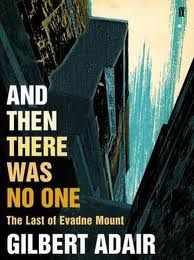
Gilbert Adair, in the third of his Evadne Mount novels, changes tack and disposes with the cosy Christie model subverted successfully in The Act Of Roger Murgatroyd and less so in A Mysterious Affair Of Style, by opting to throw himself into the mix and tell the story of And Then There Was No One (2009) as a fictional memoir. Set in 2011, Adair has found himself at a literary festival in a Swiss town by the Reichenbach Falls, setting for Conan Doyle’s attempt at ridding himself of his popular detective character.

The influence of Sherlock Holmes plays as much a part in And Then There Was No One as that of Agatha Christie has for the triptych of Evadne Mount novels, and fans of Holmes may be interested to know that Adair reproduces, in full from his fictional new book of Sherlock Holmes stories, his take on The Giant Rat Of Sumatra, first mentioned in The Adventure Of The Sussex Vampire (cf The Casebook Of Sherlock Holmes) as “a story for which the world is not yet prepared”.

The reason for this change in the style of the novels comes late, but is worth mentioning, as Adair regularly talks about his novels, past, present, and in translation throughout:

For all my efforts to have the second novel ring as many changes on the first as was organically feasible within the generic conventions I was pastiching, there remained a stubbornly samey something about A Mysterious Affair of Style which long afterwards nagged at me. And not only at me. One reviewer, praising the book, had also expressed disappointment that I had taken an ‘if-it-ain’t-broke-don’t fix-it’ attitude to the first of the cycle, and I couldn’t help agreeing with him.

Like that novel, Adair begins by playing with the conventions of the murder mystery genre. Where the murder didn’t occur until late in A Mysterious Affair Of Style, the murder has long since been wrapped up here. The victim is Gustav Slavorigin,  a Booker Prize-winning author sent, after publishing a collection of incendiary anti-American essays, into hiding, Rushdie style, due to a contract on his head, courtesy of a rich Texan reactionary.

The prologue, seemingly extraneous to the mystery itself, fills in details that, to a first read, seem dry and dull, and in doing so recalls both the introduction to Eco’s The Name Of The Rose and the short foreword to Nabokov’s Lolita. This in itself is strange, given that Adair has mentioned in the past that Nabokov has “become something of an albatross about [his] neck”. The details of this chapter deal with the history of Slavorigin - his early days at university, with Adair, through the rise, fall, and infamy of his writing career. One notable book, and the reason Slavorigin is making a rare public pitstop, is his new thriller, A Reliable Narrator, which gives the game away without, if you catch my drift, doing so.

How to describe A Reliable Narrator? Its opening chapter resembles the concluding chapter of a whodunnit, one that just happens never actually to have been written. Thus the reader of Slavorigin’s book (I mean, the book which was written) cannot hope to comprehend the picturesque twists of this first-chapter denouement since, of the murder which has clearly taken place, the only detail to which he is made privy is the identity of the murderer, a murderer who has already been apprehended, charged, tried, found guilty and sentenced to life imprisonment.

The idea of a reliable narrator is played around with too, as is Adair’s playful style. Personal views come into the fray, such  as calling the forty-five minutes of literary festivals “so much hassle for so little result” and his description of a book as being “a fat, virtuosically executed novel by one of that new breed of American wunderkinder who, I would be lying if I denied it, are positively bloated with talent but who are also just too fucking pleased with themselves.” As a fictional Adair, he’s able to get away with it, even if, with reference to Slavorigin’s book:

The first-person protagonist is no canonic unreliable narrator, such a tired old cliché of postmodernism now, but a perfectly reliable narrator, except that not a single soul is prepared to rely on him.

The usual alliteration, literary and cinematic in-jokes, and postmodern trickery are present and accounted for in And Then There Was No One. The unashamed use of puns (’Google Gogol’, a delicatessen named ‘Salvador Deli’ and a few more Nabokovian references, ‘Son of Palefire’ and ‘Adair or Ardor’) adds to the fun, and I’d like to think that only Adair’s style, like a British eccentric, could get away with a metaphor like “the train tranquilly unzipped the country’s flies from Oxford to London”.

One of the more interesting ploys in the novel is how, as a memoir, Adair manages to introduce his sleuth, the Dowager Duchess of Crime, Evadne Mount, into real events. As the last novel was set in the 1940s and this novel is seventy years hence, and she should be the one dropping dead, he pulls it off well, and humorously, too, introducing her into a book that she should never be written, as per a Q&A session after his reading of The Giant Rat Of Sumatra:

‘You wrote two pastiches of Agatha Christie, The Act of Roger Murgatroyd and A Mysterious Affair of Style? Will there be a third?’ Me: ‘Absolutely not. I have had my fill of cardboard characters and preposterous plotlines. What I desire to write now is something more personal, a work of genuine depth and ambition.

Amongst the answers at that session there are some interesting insights that, if we believe the reliable narrator, into Adair that show And Then There Was No One as being that personal work, bringing with it a few questions of its own:

‘I read a book, Alice in Wonderland, Peter Pan, Les Enfants terribles, Death in Venice, or whatever, I like it, I rewrite it. I am in short a pasticheur. Less by opportunism, though, than by superstition. I long ago discovered that I could embark on a new work of fiction only if its premise had already been legitimised by one of the writers in my personal Pantheon. Each of my novels is thus a palimpsest. Scrape away at its surface and you will find, underneath, another novel, usually a classic. I offer no apology for this.’

Apologies are not in order as Adair has produced his best novel since 1992’s The Death Of The Author. His funniest, too. It has more conceptual twists and turns than the labyrinth in Eco’s The Name Of The Rose, another novel that owes a debt to Sherlock Holmes, and probably why the Italian writer was also due to attend the same literary festival. In fact, in Eco’s essay, Travels In Hyperreality, he says that ‘once the “total fake” is admitted, in order to be enjoyed it must seem totally real’, and this is what Adair does with this novel, giving us a reliable narrator, so reliable that we can believe his every word, only to have the rug pulled out from under us, to see it for what it is, yet still believe.


Find out more at: Amazon UK | GoodReads

Be the first to comment on this review. »

AddThis Social Bookmark Button

Gilbert Adair: The Key Of The Tower

September 24th, 2008 Stewart

Posted in Vintage, crime, humour, first person narrator, thriller, Scotland, Adair, Gilbert

Gilbert Adair: The Key Of The Tower

Regular readers of this site are no doubt sick of the mention of Gilbert Adair, given that he’s the most reviewed writer here and I’ve already reviewed the brilliant The Death Of The Author this month. Bear with me, though, for there’s not much of his fiction to go before I can begin to pester with another obsession.

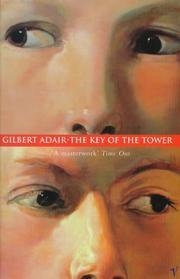
The thing with Adair is that there’s no real consistency to his books. After enjoying the postmodern murder mystery of The Act Of Roger Murgatroyd, he followed it with the lesser A Mysterious Affair Of Style; similarly the high of The Death Of The Author was followed by The Key Of The Tower (1997), arguably the weakest in his ouevre.

Dud or not, reading Adair’s prose is always a delight, purely for the unashamed fun he has with wordplay and subverting expectations. Reading him is always like sitting down to listen to an old friend that you don’t quite trust.

Where other Adair novels wear their literary influences on their sleeve, the obvious comparison for The Key To The Tower is not to be found in books, but movies. Hitchcock’, especially. From the off Adair sets up a scene that wouldn’t be out of place in one of Hitch’s features: two cars on a road in Brittany, both halted by a fallen tree. One of the drivers is Guy Lantern, on holiday from England in his second-hand Mini; the other, in his Rolls-Royce, is Jean-Marc Cheret, a wealthy art dealer. On deciding that the only logical choice is to swap cars and drive off to their intended destinations, meeting up three days hence, they exchange car keys and the story begins.

Cheret disappears from the picture for the novel is narrated by Guy Lantern, the man in the Mini. Continuing on, he reaches where he was headed: the small town of Saint-Malo. After a comedy of errors, Lantern meets Cheret’s wife,  Béa.

Am I, I couldn’t resist putting to myself, am I going to fall in love with her? What a fantasy! It was absurd and puerile and yet…and yet, apart from the unique set of circumstances of our meeting, the romantically corny lightning flash (fate’s patented trademark, its tired old logo) and the swapping of cars, my excuse, my sole excuse, for thinking such a thought was the fact, the indisputable fact, that we all of us lead a double life. No one can monitor our loves and lusts. No one can set police dogs sniffing around the insides of our brains. Sexual attraction is what cosmologists term a singularity. It’s the black hole of the psyche, where the priorities of the realist imperative no longer apply. In my head at least, I told myself, I could do as I pleased.

Ah, the priorities of the realist imperative need no longer apply. It’s a fitting line to throw into the narrative, as it carries a second meaning - it refers to the narrative itself, because from this point onward, what had been a suspenseful and psychological thriller, à la Hitchcock, descends into a whimsical catalogue of unbelievable events, actions, and dialogue.

The basic premise centres around Lantern becoming innocently embroiled in an illicit art trade. It’s pure parody, with knowing winks aplenty, and a range of characters so over the top - like a gangster who uses Proust’s À la recherche du temps perdu as his Bible - as to undermine the initial seriousness of the book: the suspense is wrung out, the characters lose dimensions as the pages turn. Even the way in which Lantern learns of the crime he’s involved is done in that clichéd style where the criminal delights in having their misplaced genius accounted for:

Béa nodded - and again, I had the feeling that she was willing me on, wanting me to know that I was getting warm, nodding only in acknowledgement of what I had already found out but as if encouraging me on to ever further revelations, drawing each new fragment of truth out of me as, clue by clue, some general-knowledge staple - please sir, 1066 - may be drawn out of a schoolchild.

In all, The Key Of The Tower is a book of halves, strictly divided by the fall of a tree, be they plot points or the structure itself. While the notion of Adair doing Hitchcock is novel, his drive to parody the genre comes off wanting, and I have no doubt that if he’d stuck to maintaining the atmosphere and suspense then a better novel may have appeared. It now seems, however, that when Adair touches on Hitch (Alistair Farjeon in A Mysterious Affair Of Style is pretty much him in all but name) it may just be best to avoid.

But, damn him, there’s no way you can avoid him because, at his best or not, he’s just so readable as to almost forgive him. At the start of the novel there’s a long description of the Mini’s windscreen wipers, with the occasional snatch of the road ahead. While it primarily relates to Lantern’s journey through Brittany, it’s also reads as a clever portent for the reader.

And at those brief moments when the windscreen had been wiped clear, and before a brand new rash of raindrops erupted, it would come as a slight but real surprise, it would even obscurely disappoint me, that the scenery hadn’t meanwhile been shifted and that the dark mute road in front of me remained unaltered, with only an occasional signpost, preternaturally aglow in the gloom, to attest that I had made any headway.

Come the end of The Key Of The Tower, having barely had the rug pulled out from under itself, the scenery hasn’t shifted, the road is unaltered, and aside from a nod here and there, there’s little to recommend it. He’s right, though, that does come as a surprise.


Find out more at: Amazon UK | Amazon US | GoodReads

2 responses so far. Keep them coming. »

AddThis Social Bookmark Button

Gilbert Adair: The Death Of The Author

September 5th, 2008 Stewart

Posted in death, intertextual, postmodern, Melville House, satire, education, Scotland, murder, unreliable narrator, first person narrator, Adair, Gilbert

Gilbert Adair: The Death Of The Author

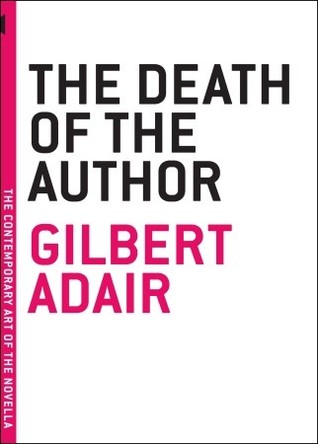
While I’ve read a number of Gilbert Adair’s recent books, the older titles from his back catalogue are out of print. One of these titles, The Death Of The Author (1992), has thankfully been given a second lease of life in the United States, thanks to Melville House Publishing’s new Contemporary Art of the Novella series, a companion to its Art of the Novella, a series showcasing the likes of Joyce, Flaubert, Proust, and Tolstoy.

But the Contemporary range is no stranger to lesser known names itself - The Pathseeker, by Nobel laureate, Imre Kertész was the flagship title So, good company indeed. And, when my copy of The Death Of The Author dropped through the door, so impressed was I by the production values (glossy cover with flaps, bold colour, and nicely tactile pages) that I made the snap decision to purchase all the others within the series, with the intention of subscribing to future releases too.

But to the book. Adair’s work - his fiction, anyway - tends to fall one of two ways: the light entertainment, like his Evadne Mount trilogy; or the heavier entertainment, erudite, but still light. All come with an element of postmodernism. And The Death Of The Author, falling on the erudite side, is a postmodern book about postmodernism.

Although my reading of the book went without knowledge of the events that inform it, I daresay it’s not necessary in enjoying the novella. The reference point is Paul de Man, the Belgian literary theorist whose work had a different light shed upon it when it was discovered  he had written collaborationist articles during World War II, including one of an anti-Semitic nature. De Man’s life story, of living during wartime and teaching in the States, is given here to our narrator, Léopold Sfax.

Sfax is a celebrity in the world of literary criticism, having published two books, the first a study of Yeats:

That book, whose appearance produced quite a commotion, I may even say a scandal, in the advanced academic circles of the day, was Either/Either - I realized I had “arrived” when the Partisan Review reviewer wrote of it as having been wildly overrated, for to be described as overrated by one critic meant after all that I had been highly rated by several.

In it, Sfax argues that literary meanings are not intentions of their authors, no matter what they say - that it’s the reader and their interpretation, be it this or that, that makes the meanings. Following on from this book is the one that makes his career, The Vicious Spiral, the book whose arguments, not given a name, become simply known as ‘the Theory’.

The more closely a text is studied the more insidiously is it drained of sense or legibility, just as the more fixedly a word is stared at on the page the more too is it drained of legibility or sense, striking the increasingly bewildered eye as a mere weird disconnected sequence of squiggles. Words are far older and fickler and more experienced than the writers who suffer under the delusion that they are “using” them. Words have been around. No one owns them, no one can proscribe how they ought to be read, and most certainly not their author.

If de Man is the template for Sfax’s life, Roland Barthes is the inspiration for the Theory, being an echo of his essay Death Of The Author. And it’s the popularity of this book that brings us to the opening scene as Sfax talks with a female student of his who would like to write his biograph. Of course, rather than have someone else tell his story, The Death Of The Author becomes his autobiography, and he meanders off on events in his life, coming each time to the moment that spurred him to sit down and write in the first place.

With any Adair book, being vigilant is part and parcel of reading him, for his texts are not without their games, and there’s always that delight on realising, one again, that he is one, sometimes two, steps ahead. In The Death Of The Author he more than delivers, his games bringing together a beautiful spoof of literary criticism and memoir that, toward the end, adds a murder mystery that fulfils the promise of its title. And, when this cauldron of fun comes to the boil, Adair adds a stinging twist that had me screaming, “you bastard!”

To read The Death Of The Author is not unlike what it must be like to have subscribed to Sfax’s Theory:

The world had been turned upside-down - what had always been true was false, what had been important was marginal, what had been meaningful was meaningless - and it made sense, it made sense!


Find out more at: Amazon UK | Amazon US | GoodReads

16 responses so far. Keep them coming. »

AddThis Social Bookmark Button

Gilbert Adair: The Dreamers

January 28th, 2008 Stewart

Posted in faber & faber, incest, Scotland, sexuality, relationships, politics, Adair, Gilbert

Gilbert Adair: The Dreamers

I’ve been making it a rule of late that before I see a film I should have read the book, provided it’s available in English and that I know the film is based on a book in the first place. So it has been with The Assassination Of Jesse James By The Coward Robert Ford and I Am Legend. It produces mixed results: the first one, good; the latter, bad. I’ve now had Bertolucci’s The Dreamers on DVD for some time and have been holding off watching it until I had read the book. And it being by Gilbert Adair, I’m surprised it’s taken me so long to get around to it.

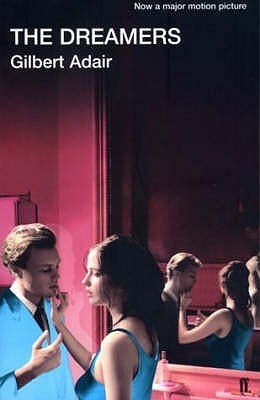
The Dreamers (2003), as Adair notes in the afterword, is a rewrite of his 1986 debut, The Holy Innocents, a novel he was never happy with and constantly knocked back offers of adaptation, only to rescind when Bertolucci came calling. Not just rescind, but seize the opportunity to put past wrongs right, and come up with a new treatment, for both book and film, which he claims “may be twins but…they’re not identical.”

It seems in literature that when young Americans come to Paris they end up caught in the moment and find themselves moving into an apartment indefinitely and enjoying lots of sex. The Dreamers, in this respect, is no different to James Baldwin’s Giovanni’s Room, as its main character, the eighteen year old Matthew, has come to Paris, and in a friendshap “matured in the white shadow of the Cinématèque screen”, has come to know Théo and his twin sister, Isabelle, although his insecurity casts doubts on his worthiness of their aquaintance:

A lonely man thinks of nothing but friendship, just as a repressed man thinks of nothing but flesh. If Matthew had been granted a wish by a guardian angel, he would have requested a machine, one yet to be invented, permitting its owner to ascertain where each of his friends was at any given moment, what he was doing and with whom. He belonged to the race which loiters underneath a loved one’s window late at night and endeavours to decipher shadows flitting across the Venetian blind.

The comparison of Matthew’s loneliness to one of repression is apt in the context of the novel as Matthew, after an embarrassing misunderstanding with a friend back in America, found “the door of the closet out of which he had momentarily stepped proved to be a revolving one” and has buried what desires he has.

Echoing Matthew’s psyche, on a larger scale but in the background of the novel, the French government, under de Gaulle has designs on repressing the liberal movement, one incediary act being the closure of the Cinématèque, a beacon on the French cultural landscape standing outside of beaurocratic borders. And, with no films to see, the trio of Matthew, Isabelle, and Théo embody the ethos of the popular saying that the show must go on, adapting films into a parlour game called Home Movies that starts with petty gambling, only for the stakes to dangerously progress into a heady steam of sexual forfeit:

The Cinématèque had been forgotten. The had a Cinématèque of their own, a Cinématèque in flesh and blood. Which meant that the game was no longer played merely whenever the inclination siezed them. While they read during the day, or played cards, or fumbled one another, the curtain would rise on Home Movies night after night, at six-thirty, eight-thirty and ten-thirty, with matinees on Sunday.

But like a screening at the Cinématèque, things must come to and end and in The Dreamers Adair brings the final curtain down on a tragic note as the events of May 1968, spurned on by the Cinématèque’s closure, slip from protest to riot. Our dreamers, long lost in their liberal world, are woken by the heavy hand of conservatism.

When I pick up an Adair novel, this being my fifth, I’ve come to expect a level of trickery but such expectations were not met here, although, in hindsight, I suppose I should anticipate the unexpected from Adair. What The Dreamers is, then, is a stylistically tame novel that, in protest at its timidity, delivers a steamy soup of friendship, desire and sin that still needs a pinch of salt. The story is assuredly told, each observation a sparkling pearl, but somewhat lacks the wit displayed, such as showcased in Buenos Noches Buenas Aires, that, for me, typefies an Adair novel and makes it something that The Dreamers can only, well, dream of.


Find out more at: Amazon UK | Amazon US | GoodReads

3 responses so far. Keep them coming. »

AddThis Social Bookmark Button

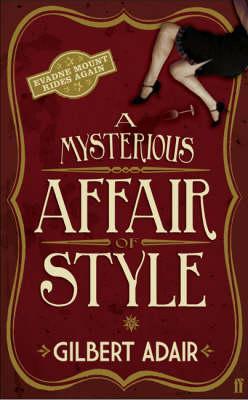
Gilbert Adair: A Mysterious Affair Of Style

December 19th, 2007 Stewart

Posted in postmodern, faber & faber, crime, intertextual, humour, Scotland, murder, satire, Adair, Gilbert

Gilbert Adair: A Mysterious Affair Of Style

It’s not often that I read books by the same author one after the other but I enjoyed Gilbert Adair’s The Act Of Roger Murgatroyd so much that the only logical thing to do was dive straight into its sequel - and second book in the Evadne Mount trilogy - A Mysterious Affair Of Style (2007). I was hoping for more of the same, a murder mystery with a postmodern twist, and, in this, it delivered, although I was left feeling that I’d read it too soon after The Act Of Roger Murgatroyd, and this put it firmly in the shadow of its predecessor.

Where the action of the first novel took place within the claustrophobic environs of ffolkes Manor, A Mysterious Affair Of Style shifts to London, notably a film studio, in the 1940s. As expected, references to the golden age of crime fiction are there and, given Adair’s passion for cinema, are coupled with plenty of jokes (and in-jokes) pertinent to the film industry that generally work, although a few soon become tiring such as the ongoing confusion over the roles of director and producer.

It’s ten years since Evadne Mount solved the case at ffolkes Manor and, as Chief Inspector Trubshawe, formerly of Scotland Yard, notes when they bump into each other at the Ritz, recognising each other instantly as, in a nod to Agatha Christie, who never let Poirot grow old, “It’s almost as though time stood still”. From here these two old partners in (solving) crime renew their friendship and it’s only a matter of time before Mount’s actress friend, Cora Rutherford, is inviting them to watch her on the set of Alastair Farjeon’s (a thinly disguised Hitchcock) new film, If Ever They Find Me Dead.

Fittingly Farjeon has been found dead and his assistant is in control of the new film. As it is, the production is skating on thin ice and all it doesn’t need is more tragedy striking, which is exactly what happens when the aforementioned actress drops dead during filming. Now, while there are plenty of suspects for Mount and Trubshawe to bring to task for the murder, none of them have a motive. And the stakes get higher when the elderly couple challenge each other in the solving of the case with some drastic forfeits should either lose.

A Mysterious Affair Of Style hobbles along on its own momentum, pausing for long dialogues and passages on the nature of whodunits, throwing in all manner of jokes literary and cinematic, obvious and obscure. For examples. Mount’s favourite exclamation - “Great Scott-Moncrieff!” - is a reference to the translation award Adair won for bringing Perec’s La Disparition to English as A Void. Whereas a film titled An American In Plaster-of-Paris is bordering on groanworthy. Regardless, it’s all playful, even if it doesn’t alway pay off.

For a murder mystery there’s not much sleuthing either, Mount eschewing logical methods and instead trusting the intuition of her itchy bottom. But, as murder mysteries go, A Mysterious Affair Of Style doesn’t quite deliver and this may be because, as in Mount’s words, referring to one of her less successful novels, “it’s too clever for its own good. It’s what you might call clever-clever, which sounds twice as clever as clever itself but is actually only half.” This is certainly true of the conclusion which don’t really hit as hard as Mount’s formula for crime writing:

“When the revelations come tumbling out one after the other, the impact on the reader has got to be instantaneous. They’ve got to hit you - practically smack you - in the face.”

While it’s a readable, playful book - trademark Adair, then - it is capable of instigating the occasional smirk at its knowing humour and references, but as a whole it doesn’t really deliver. There may be more to it, as deliberate spelling errors - missing letters, additional letters - can be found at many points. To my mind the mysterious affair of style, aside from that within the novel, is the notion that Adair is emulating Mount’s style and the errors may hint that something is not quite right, and if so, then, through his main character, the author throws one last knowing wink to the reader:

“My publishers, my readers, my critics - well, most of them,” she qualified, not quite suppressing an embryonic snarl - “they all tell me that my latest book, whichever it happens to be, is wonderful, is terrific, is the finest so far, though we all know it’s a dud.”


Find out more at: Amazon UK | Amazon US | GoodReads

1 response so far. Why not add your thoughts? »

AddThis Social Bookmark Button

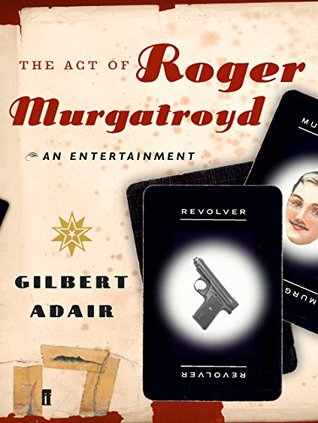
Gilbert Adair: The Act Of Roger Murgatroyd

December 11th, 2007 Stewart

Posted in postmodern, faber & faber, crime, humour, satire, Scotland, murder, locked room, Adair, Gilbert

Gilbert Adair: The Act Of Roger Murgatroyd

Having fallen into a reading slump recently, which is somewhat criminal of me, I decided to look for something light, fun, and potentially enjoyable. So, who better an author to sit back with than Gilbert Adair, a man whose novels come laden with lingusitic tricks and twists? And what better a book than The Act Of Roger Murgatroyd (2006), if only because its subtitle is An Entertainment. Oh, I needed entertaining.

This book, then, is a pastiche of the murder mystery genre, the style fitting that of the Agatha Christie mould. In fact, its title is a play on Christie’s The Murder Of Roger Ackroyd, which I’ve never read, so I’m sure there are plenty of in-jokes that went over my head, although ignorance of them is not needed in order to enjoy this novel. But, that one novel aside, there are many nods and winks to Miss Marple and Hercule Poirot that I was able to pick up on, if only through television adaptions.

Set on Boxing Day, in 1935, Raymond Gentry (”a professional snitch”) is murdered in the attic of ffolkes manor in Dartmoor. What makes it all the more intriguing is that the attic is locked from the inside. Snowed in with everyone suspicious of the other, step forward Evadne Mount, writer of the Alexis Baddeley series of whodunits, and Chief-Inspector Trubshawe, retired of Scotland Yard, to solve the case. And solve it they do, albeit with little sleuthing and much dialogue, making this somewhat reminiscent of Adair’s A Closed Book, while being nothing like it at the same time.

As you would expect, especially after he has unearthed much of their dirt, everyone in the manor has their own motives for killing Gentry, which Mount relates to Trubshawe:

You’ll excuse me, I trust, if I decline to go into greater detail about the painful things we all had to hear about each other. All I’m prepared to say is that, when we turned in that night, there wasn’t one of us who wouldn’t have rejoiced if Raymond Gentry had been struck down by a thunderbolt.

Or, for that matter (she concluded), by a bullet.

As you can tell from that passage, Adair enjoys playing within the conventions of the classic murder mystery, knowingly using stereotypes and clichés that would otherwise damn a novel, which Trubshawe lists in one of his fiction versus reality rants that I can only assume references actual Christie novels:

“…apart from locked rooms, you’ll find the whole trumpery bag of tricks. You know, a secret passage that only the murderer has a key to. A clock and mirror facing each other at the scene of the crime, meaning the dial was read in reverse. Some black sheep of a family shipped off to South Africa and supposed to have died there, except that nobody’s certain he really did. All the usual whodunit hoohah. Load of codswallop, if you ask me. “

So how does The Act Of Roger Murgatroyd differ from more cosy murder mysteries? Well, one way is to add a postmodern slant to the text, so that not only do we have a narrative but a conscious playing with the structure. Another is to include references to the author, the publisher (faber & faber) and observations of how it’s just like being in a book. And finally, there’s the ballsy unveiling, without being in any way a spoiler, of the murderer in the title. But while I never solved the crime myself, despite a few moments where I circled around the rather ingenious solution, I’m proud I wasn’t led along by the many red herrings scattered throughout.

In comparison to other Adair novels, The Act Of Roger Murgatroyd is lighter in tone, the verbal trickery not as intense as something like Buenas Noches Buenos Aires, but it’s still, just as it promises, entertaining. And being the first in the Evadne Mount trilogy, there’s thankfully two more acts to look forward to.


Find out more at: Amazon UK | Amazon US | GoodReads

1 response so far. Why not add your thoughts? »

AddThis Social Bookmark Button

Gilbert Adair: Buenas Noches Buenos Aires

August 12th, 2007 Stewart

Posted in unreliable narrator, first person narrator, faber & faber, homosexuality, AIDS, sexuality, Scotland, Adair, Gilbert

Gilbert Adair: Buenas Noches Buenos Aires

That Gilbert Adair’s Buenas Noches Buenos Aires opens with an emphasis on how true the ensuing story is, the reader has every right to be suspicious. But, other than a noticeable handul of clues, I’m at a loss as to why such dubiety need be cast upon the text. Adair has a reputation for novels with more tricks up their sleeve than most, but it feels like a straight story all the way. Despite the subject matter, of course.

Gideon A. - same initials as the author - is a young homosexual, nescient to the world he craves but with a handful of embarrassing sexual failures behind him. He leaves his Oxfordshire home and moves to Paris, taking a job as an English teacher at Berlitz. There he’s happy to discover that the majority of the all male common room is gay. Here he listens to the stories of their varied conquests and, in order to fit in, imagines and tells his own sex-laden anecdotes.

It’s okay for a while but, this being the early eighties, there comes the arrival of a “gay cancer”, initially dismissed by one character as no more probable than gay gallstones. It’s not a big issue at first, given that the disease is prevalent in America. But when symptoms start showing closer to home, the reality of it becomes apparent. Gideon, however, sees it as his chance to become more sexually active. If more gay men abstain from sex then, in all probability, that would make him a highly sought after partner. It’s a twisted logic, but it seems to work for him.

The storyline of Buenas Noches Buenos Aires sometimes feels secondary to Adair’s - or should that be Gideon’s? - erudition and verbal games. There’s all manner of references to literature, artists, and architecture - mostly French- and sometimes famous novels, with utmost subtlety, get namechecked (e.g. Flaubert’s Sentimental Education, Caldwell’s God’s Little Acre). The wordplay is a virtuoso performance, puns and poetry coming together to form descriptions, jokes, and more. Then there’s the sex. Plenty of it, all told in a no holds barred stream of graphic prose, illuminating all manner of sexual quirks.

So how much of Buenas Noches Buenos Aires are we meant to take as canon in Gideon’s life? Admittedly, it’s unknown. There are perhaps a few clues within his narrative:

A timid soul, was my report card’s conclusion., an appraisal that had me spluttering with rage. Something of a poseur, was the overall view. Which I suppose I was, except that, if you imitate something for long enough, you eventually turn into it.

And:

It was a good story, well told, and I seriously doubt that any of my listeners were capable of spotting the joins - which is to say, working out where reality ended and fantasy began.

But who really cares what’s fact and fiction when it’s this good? Buenas Noches Buenos Aires is a tricksy little novel that turns its attention to the advent of the AIDS epidemic amongst libertarian circles. It’s witty, stylish, immensely readable, somewhat reminiscent of Muriel Spark’s The Driver’s Seat but with much more substance. And despite the saddening subject matter it’s a novel that certainly has a good air about it.


Find out more at: Amazon UK | Amazon US | GoodReads

5 responses so far. Keep them coming. »

AddThis Social Bookmark Button