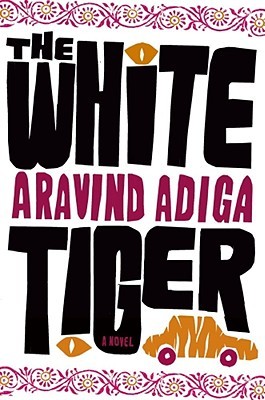
Aravind Adiga: The White Tiger

August 3rd, 2008 Stewart

Posted in power, Adiga, Aravind, booker 2008, Atlantic Books, humour, corruption, poverty, murder, first person narrator, India

Aravind Adiga: The White Tiger

If you are tired of Indian novels built on a blend of saffron and saris then Aravind Adiga’s The White Tiger (2008) may just be the antidote required. It’s take on modern India is one more grounded in reality than romantic idealism, straddling the thin line between the historical hangovers of British rule and ingrained caste system with the thriving industry of entrepreneurship now prevalent in outsourced business, such as information technology and call centres.

One such entrepreneur is Balram Halwai, “Bangalore’s least known success story”, from a caste of sweet-makers, who wants to share the story of his personal struggle. Interestingly, he has decided to share it with Wen Jiabao, Premier of “the Freedom-Loving Nation of China” who, it is announced on the radio, is coming to Bangalore in the next week. Rather than the falsity of handshakes and namastes between political leaders, Balram opts to show India warts and all through a series of lengthy letters.

Balram’s path to entrepreneurship, as he tells Wen Jiabao near the beginning, has begun by slitting his master’s throat. His master, incidentally, is one of the four landlords who run the area around Laxmangarh, known as the Animals. (”…the Animals stayed and fed on the village, and everything that grew in it, until there was nothing left for anyone else to feed on.”) As a driver in the service of the Stork and his sons, Balram picks up snippets of information he hears both at home and behind the wheel. And it’s the rise from teashop boy to modern Indian man (via murderer) that is recounted for the benefit of the Chinese Premier. (”…sir, you are far ahead of us in every respect, except that you don’t have entrepreneurs.”)

What has allowed Balram the audicity to speak are the changes in India. Many years before, the country was like a zoo, where people of certain castes were confined to their cage.

And then, thanks to all those politicians in Delhi, on the fifteenth of August, 1947 - the day the British left - the cages had been let open; and the animals had attacked and ripped each other apart and jungle law replaced zoo law. Those that were the most ferocious, the hungriest, had eaten everyone else up, and grown big bellies. That was all that counted now, the size of your belly. It didn’t matter whether you were a woman, or a Muslim, or an untouchable: anyone with a belly could rise up.

But, for all those that don’t rise up, there’s the millions left in the Darkness, of which Balram’s home of Laxmangarh is “a typical Indian village paradise”:

Electricity poles - defunct.

Water tap - broken.

Children - too lean and short for their age, and with oversized heads from which vivid eyes shine, like the guilty conscience of the government of India.

Balram’s chances of escaping such poverty don’t look so good, his family having taken him out of school and putting him to work in a teashop.

Go to a teashop anywhere along the Ganga, sir, and look at the men working in that tea shop - men I say, but better to call them human spiders that go crawling in between and under the tables with rags in their hands, crushed humans in crushed uniforms, sluggish, unshaven, in their thirties or forties or fifties but still ‘boys’. But that is your fate if you do your job well - with honesty, dedication, and sincerity, the way Ghandi would have done it, no doubt.

If doing your job well means enduring it for life, Balram proves himself to be, as a school inspector once noted, “the rarest of animals - the creature that comes along only once in a generation” - a white tiger. Rather than live a life at the bottom, Balram takes fate into his own hands and takes a different path to Ghandi’s, because only with dishonesty and insincerity can you plot to reach for higher grounds. (”…the Indian entrepreneur has to be straight and crooked, mocking and believing, sly and sincere, at the same time.”)

What is good about Balram’s letters are his ignorance of the man and the country he is addressing (”Now, since I doubt that you have rickshaw-pullers in China - or in any other civilised nation on earth - you will have to see one for yourself.”), having picked up his knowledge from a book entitled Exciting Tales of the Exotic East. This is indicative of the nature of entrepreneurs, who are “made from half-baked clay”:

Me, and thousands of others in this country like me, are half-baked, because we were never allowed to complete our schooling. Open our skulls, look in with a penlight, and you’ll find an odd museum of ideas: sentences of history or mathematics remembered from school textbooks…sentences about politics read in a newspaper…bits of All India Radio news bulletins…all these ideas, half formed and half digested and half correct, mix up with other half-cooked ideas in your head, and I guess these half-formed ideas bugger one another, and make more half-formed ideas, and this is what you act on and live with.

In the telling, The White Tiger is reminiscent of last year’s Booker nominated The Reluctant Fundamentalist, give that we are left to wonder at Wen Jiabao’s reaction to Balram’s letters, assuming he even gets them. And in it’s getting down and dirty with the downtrodden of India, and sparks of east meets west, there’s a dotted line to be drawn to Indra Sinha’s Animal’s People, although the book that springs to mind most is Kazuo Ishiguro’s The Remains Of The Day, purely for the parallel of a man, his master, and the oblivion between.

Its players, being drawn from the the top to bottom of Indian society, are tight in scope, allowing Adiga to get to grips well with them and how they interact with each other, whether it be the relationships between master and servant, between family members, or between the state and civilians. In all, The White Tiger provides an evocative and miserable landscape stripped of any exoticism one might expect, where everyone is greasing the palms of others, and anyone with the stomach for it can make their mark. And being easily digestible, your own stomach need not worry, for the novel is anything but half-baked.


Find out more at: Amazon UK | Amazon US | GoodReads

18 responses so far. Keep them coming. »

AddThis Social Bookmark Button