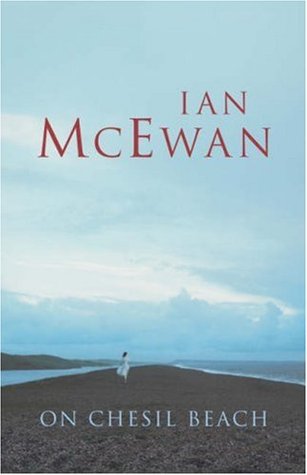
Ian McEwan: On Chesil Beach

August 19th, 2007 Stewart

Posted in Jonathan Cape, booker 2007, marriage, love, relationships, England, McEwan, Ian

Ian McEwan: On Chesil Beach

While most of the Booker debate regarding Ian McEwan’s On Chesil Beach seems to be about its length and whether it qualifies as a novel, I say it doesn’t actually matter since, back in 1980, J.L. Carr’s A Month In The Country was much shorter yet made the shortlist. The other charge of course is that it’s an Amsterdam, an inferior novel being pushed to rewards while the better stuff goes unrecognised. Well I quite liked Amsterdam, so I was looking forward to On Chesil Beach. And it didn’t disappoint. Not entirely, anyway.

Florence and Edward are newlyweds - and virgins, this being 1962 when “a conversation about sexual difficulties was plainly impossible”. After their wedding they have taken themselves off to their honeymoon suite facing onto Chesil Beach. Here they have a meal they have little appetite for before moving to the bedroom to consummate their marriage. It’s this latter event that provides much of the novel’s (or is that novella’s?) tension, for while Edward has waited and waited to make love to his wife (”though his fear of failure was great, his eagerness - for rapture, for resolution - was far greater”), Florence has been dreading the day:

Florence suspected that there was something profoundly wrong with her, that she had always been different, and that at last she was about to be exposed. Her problem, she thought, was greater, deeper, than straightforward physical disgust; her whole being was in revolt against a prospect of entanglement and flesh; her composure and essential happiness were about to be violated. She simply did not want to be ‘entered’ or ‘penetrated’. Sex with Edward could not be the summation of her joy, but was the price she must pay for it.

The way in which McEwan tells the story of this couple works well, dipping between their thoughts and anxieties. One page has us seeing Edward’s happiness to have his new wife, yet worrying over whether, when they go to bed, he will, as the euphemism goes, “arrive too soon”. Then it’s a trip into Florence’s head as she gripes about how she dislikes kissing (and all other contact, really) and how she can’t be a good wife if she can’t even contemplate fulfilling what she believes are her duties as a wife. But, interspersed with these wedding day worries, are sections of pure exposition that head back into their lives prior to current events. Sure, it gives them a background, but it feels all so unnecessary, taking the reader out of the moment (which is truly interesting) and giving a family history lesson that we could do without.

Even where the structure is a let down, the prose remains a joy. McEwan’s choice of words demonstrates his particular talent at painting, with a few measured strokes, a whole scene. And when he gets into the mind of his characters he truly explores them to the point that we know that beyond the page their lives still go on. But On Chesil Beach does suffer by the time the end comes round. What had started as a slowly lapping wash of narrative becomes, in its closing pages, a tsunami of events flashing forward into the future, explaining the relationship.

Without the lengthy flashbacks explaining the newlyweds, On Chesil Beach would certainly be in novella country, and perhaps that’s where it should have stayed. The study of two people whose love for each other is frustrated by lack of communication is a wonderful tale to be told and here it’s done so well - the rest is just padding. It’s a strong narrative but McEwan-lite. Let’s hope he has something more substantial landing on our shores soon.


Find out more at: Amazon UK | Amazon US | GoodReads

5 responses so far. Keep them coming. »

AddThis Social Bookmark Button

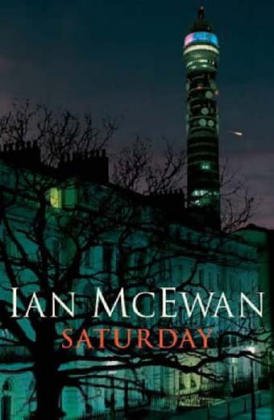
Ian McEwan: Saturday

June 1st, 2007 Stewart

Posted in 1001 Books, Vintage, England, McEwan, Ian

Ian McEwan: Saturday

Ian McEwan’s Saturday is the story of Henry Perowne, a London based neurosurgeon, as he reflects on his life via the events that happen during his day off. Mixing organised chores with random incidents, the novel provides a great character study, one of a man coming to terms with his advancing years, although the book is low on action.

One morning, Perowne wakes early to witness an aviation accident, which troubles him throughout the day. As the day progresses he makes love to his wife, gets involved in a traffic accident, gets beat at squash, buys fish, visits his sick mother, listens to his son’s band perform, argues politics with his poetess daughter, and settles down for a family meal in the evening. While all this happens, the London march against the impending war in Iraq gathers momentum.

The characters are extremely well done with the exception, perhaps, of Daisy, Perowne’s daughter, who simply argues her anti-war stance and hides her own little secret. Daisy and Theo, his son, are, unlike their father, creative souls, and at the age where they are ready to flee the nest. Baxter, the novel’s main antagonist, is a young man rendered emotionally unstable by a degenerative brain disease, embarrassed by his condition yet unable to prevent its detriment to his life. And Perowne, through all this, meditates on everything, no matter how seemingly insignificant, and the author presents him as emotionally ambivalent man; a man slow to take sides, but always willing to consider the wider picture.

The plot is small but the emotional and philosophical conclusions drawn from each observation or incident serves to complete the picture of Henry Perowne’s day. In the evening, Baxter returns to cause havoc with the surgeon’s family, a scaled down metaphor for the impending invasion of Iraq being an example of how one event, no matter how minimal, can lead to big changes in one’s life.

Overall, McEwan has crafted a novel worthy of praise, but its meditative assault can be overwhelming at times; the use of neurosurgical terms is difficult for the layman, but our protagonist is a neurosurgeon so it’s more than appropriate. It’s certainly relevant to the current political climate, and probably serves as a slightly autobiographical account of McEwan’s feelings as his own family grows up and becomes independent. Saturday is worth the read, for an interesting study of making sense of the world, and of growing old; or, as Perowne says, Saturday will become Sunday.


Find out more at: Amazon UK | Amazon US | GoodReads

1 response so far. Why not add your thoughts? »

AddThis Social Bookmark Button