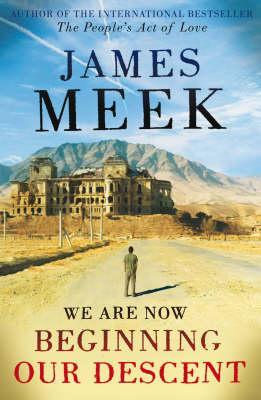
James Meek: We Are Now Beginning Our Descent

March 18th, 2008 Stewart

Posted in fate, Canongate, jealousy, alcoholism, Scotland, relationships, love, war, Meek, James

James Meek: We Are Now Beginning Our Descent

When it comes to writing a novel, there are two approaches: doing it for the art and doing it for the money. In James Meek’s novel, We Are Now Beginning Our Descent (2008), Adam Kellas is doing it for the money. And why not? His career as a warzone reporter is fraught with danger and journalists in his line of work go from one contract to the next. Writing a commercial thriller and the subsequent sales would give him the security he needs in order to sit down and write the books he really wants.

And security is what he needs, what with a divorce behind him, adding to a history of relationships which never work out and he finds difficult to get over. One such affair was with an American journalist, Astrid, during his time in Afghanistan. Yet one day, while boarding a helicopter, she jumps out as it’s taking off and he never sees her again. It’s no surprise that such a lack of closure should play on his mind. That he should let it guide him, well that’s another matter.

So when he receives an email from Astrid asking him to come and see her, he doesn’t think twice about boarding a plane, without even so much as a coat. (”He had wanted to see her for a year and now she asked to see him, and he was coming.”)

The subsequent journey fills the greater portion of the novel, although little of the journey is described. Not because it would be boring, but because Kellas is too busy wrestling with recent events to notice what’s going on. Women have left him, he’s quit his job (the book advance is a six figure sum), the war is getting to him, and in one explosive set piece, he lays waste to his best friend’s house. It’s no surprise, therefore, to hear the announcement of ‘we are now beginning our descent’ as the plane comes into New York. But for Adam Kellas, he has already begun, casting off partners, his job, and friends along the way.

That Kellas was inadequately dressed for the season marked him as a loser. The suit and shoes were plain enough warning in themselves that here was someone in themidst of their descent from security to insecurity, a man yet to settle in his new location on the bottom.

Like Kellas, Meek is no stranger to reporting from undesirable countries such as Afghanistan and Iraq. So, with the benefit of experience, the sense of place brought to the novel’s locations is impressive and feels authentic. One can almost imagine the half-buried Soviet machinery “digested by the tissue of the road” and the feeling of being there, as it happens, with other journalists pushing for stories in the face of tragedy really shines through:

A barefooted Afghan man in grimy grey clothes and a gold cap squatted in the dirt in fron of the bombed house. it was his house. The explosion had killed his wife while she was sewing clothes for a wedding, and wounded his two children, his mother and brother. He squatted near the ruins, with his long clay-stained red hands resting on his knees, and reporters came to ask him questions. He answered, although he could not meet their eyes. For hours he had a changing little group of people standing awkwardly in front of him in western clothes, taking his picture, writing down his words and filming him. The same set of questions would be asked, and the Afghan man, whose name was Jalaluddin, would answer, and when that group of journalists was halfway through, another set would arrive and get him to start again from the beginning.

The authenticity of the Afghan landscape is never in question. Meek has lived and breathed it. But there are occasions in the novel where he let’s his grip on the narrative slip and intrudes on the story. Dialogue is usually spot on but is sometimes guilty of pushing ideas rather than relaying believable statements and sentiments. And a couple of events are implausible, even if they do get the story back on track. And going off track, even if it mirrors Kellas’ descent, his mind a maelstrom of regrets, is the hardest part of reading the novel. That and regular passages of lengthy paragraphs that can be suffocating in their relentlessness.

Where it picks up - or takes off, should that be? - is when the ideas behind the novel come to the fore. At its core it’s a novel about love and friendship, and about how people are never - and never can be - who we make them out to be. Layered over this, using Kellas’ novel as its emblem, is a criticism of modern society that has dumbed down and gone in search of the dollar; that has, like Adam Kellas, been seduced by America.

It would subvert the genre by making America the enemy - not a group with America, but the American government, the American majority, and the American way…Readers would be made to believe in a limited war to save civilization…

With the current political climate involving efforts to bring “the American way” to nations such as Afghanistan and Iraq, Meek is perhaps right that culture has begun its downward flight. But We Are Now Beginning Our Descent is not the novel to combat it, being a lesser novel to Meek’s previous effort. One wonders if The People’s Act Of Love was him doing it for the money, allowing him the leisure of writing what he wants to write. And while he slips in some remarkable imagery and turns of phrase, and proves himself more than capable of penning effective set pieces, these are lost in an abundance of prose, forcing indigestion on the tissue of the page.


Find out more at: Amazon UK | Amazon US | GoodReads

Be the first to comment on this review. »

AddThis Social Bookmark Button

James Meek: The People’s Act Of Love

May 31st, 2007 Stewart

Posted in Canongate, Scotland, Meek, James

James Meek: The People’s Act Of Love

It was the intention of James Meek that his third novel, The People’s Act of Love, should be written in the manner of the great Russian novels. While I have little to no experience in this branch of literature there were enough idiosyncrasies within the book to believe that he has, at least, achieved this. And, having spent eight years living in Russia whilst following his career in journalism, Meek may be better qualified than most to write a modern take on the Russian novel .

Set in Yazyk, a remote village in the Siberian wilderness, the novel investigates the actions of a small group of people. There is Balashov, the leader of a bizarre Christian sect; Mutz, a Jewish soldier from Prague, who is one of a number of Czech soldiers on the losing side of the Russian Revolution; Anna Petrovna, a young war widow, who lives in the town with her son, Alyosha; and Samarin, an enigmatic escapee from a Siberian prison camp, who is just passing through, being followed, so he says, by another prisoner named the Mohican.

The People’s Act of Love is high on drama, and, as the action unfolds the death of a local shaman brings suspicion to Yazyk. Samarin, being the stranger with an unverifiable story, becomes the prime suspect and is imprisoned. When he tells his story to a makeshift court, a long painful narrative about life in a hellhole called the White Garden, he garners sympathy and, at the request of the undersexed Anna Petrovna, goes to stay under her watchful eye.

As the events happen in Yazyk, further tension is added to the fears of the closeknit community by the knowledge that the Reds, winners of the Russian Revolution, are coming. A priority for them is to eliminate the Czech soldiers, men desperate to return home, and claim the town for the People. The leader of the Czech’s, a man named Matula, led his men in the massacre at Staraya Krepost for which the Reds want to exercise their own brand of justice.

Meek’s prose is wonderful, as fresh and crisp as the snow falling upon the land. In fact, the harsh temperatures of Siberia inform the prose: the description makes use of evocative words suggesting a locale lost in the emptiness of northern Asia. Characters trudge over ‘papery snow’, they wear two jackets, and even the trees are known to shudder.

Throughout the novel there are a number of scenes which are brutal but handled in such a way as to seem unimportant. A man is castrated; another is butchered and the separate parts of his body hung from a tree so that they may dry; while others are sentenced to death for no reason other than the Bolshevik ideal. Matula, also, shows his anti-Semite opinions in the way he talks to Mutz, always referring to him as ‘Yid’ and making light of his religion. It’s testament to Meek’s ability that he shows us such inhumanities without preaching and leaves it open to the reader to form their opinion on his characters.

Despite how bleak The People’s Act of Love gets, it is shot through with an underlying humour that serves some warmth to the frozen landscape. And while the jokes are old, or you know them in some incarnation, they are always spoken by the soldiers who, with their circumstances, can be forgiven as they try to maintain morale.

Another interesting slant, is the book’s passing regard to religious fundamentalism. The sect living in Yazyk are Christian but their methods and doctrines are far from standard Christianity. They are castrated to be more like angels and live without sin; a practice bewildering to some of the others living in the town. Not least of all, to Anna Petrovna, whose husband is Balashov, a soldier so devout that he gave up his wife, son, and member to be closer to God.

The main themes, however, are love and sacrifice. Anna Petrovna gives up her normal life to be with Balashov, a man she loves but can never love her again; Balashov’s love of God that he would forfeit his sexuality to be with Him; and Samarin, embodiment of the People, who would sacrifice parts of his nature so as to better prepare for the world ahead. In fact, the act of love referred to in the book’s title, comes from a conversation with him and Petrovna where he talks about eating a comrade for the greater good, beating off starvation to be able to change the world. Essentially, since the book is shot through with cannibalism references, Meek is asking if there is a right time to eat another human being.

The People’s Act of Love was longlisted for the Booker 2005 and, while I’ve not read all the books that made the eventual shortlist, I wonder if Meek may have missed out on a chance to become more of a public interest. His style is certainly enjoyable, his plotting tight, and his characters tinged with much humanity. I believe Meek’s earlier two novels were somewhat different to this book and, based on the change in direction he appears to have taken, we can look forward to an interesting voice for the future.


Find out more at: Amazon UK | Amazon US | GoodReads

1 response so far. Why not add your thoughts? »

AddThis Social Bookmark Button