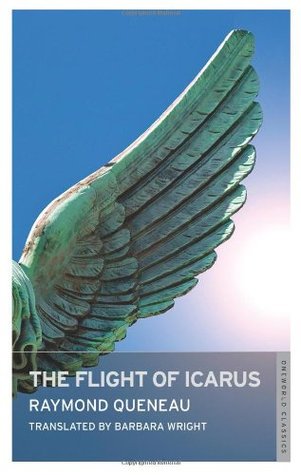
Raymond Queneau: The Flight Of Icarus

June 16th, 2009 Stewart

Posted in Queneau, Raymond, OneWorld Classics, Oulipo, humour, runaways, France

Raymond Queneau: The Flight Of Icarus

Last year I enjoyed Raymond Queneau’s Exercises In Style, arguably his most famous book, although as narrative goes it was rather slight, being the same story told ninety-nine times in all manner of styles. The title, really, is a bit of a giveaway. As such it’s been in my mind to read some more Queneau, to experience him in control of a more substantial narrative, to see how his playful style is maintained over a longer story.

So then, to The Flight Of Icarus (1968), recently reissued by OneWorld Classics and, like most of Queneau’s work, translated by Barbara Wright, who sadly passed away earlier in the year. Prefacing the novel is a note by Wright discussing the task of translating Queneau - the perceived difficulties in a novel full of wordplay and obscure references, the joy of finding solutions, and how she finds herself to be on his wavelength. It’s just as well, for The Flight Of Icarus is a novel that needs someone on the same wavelength to do it justice.

Set in Paris during the mid-1890s and told in the form of a script, the general story involves a writer - Hubert Lubert - who has lost one of the characters - the eponymous Icarus - from his work in progress in a most unusual way:

HUBERT: […] Since I am a novelist, then, I write novels. And since I write novels, I deal with characters. And now one of them has vanished. Literally. A novel I had just begun, about ten pages, fifteen at the most, and in which I had placed the highest hopes, and now the principal character, whom I had barely begun to outline, disappears. As I obviously cannot continue without him, I have come to ask you to find him for me.

MORCOL: (dreamily) How extremely Pirandellian.

Morcol is a private detective hired to track down the escaped character and where the translator, in her notes, cites Queneau as “the master of the intentionally awful pun”, here she proves herself up to the task of rendering an awful pun in English, one that leads to crossed wires and humorous circumstances:

HUBERT: [..] Here - take these ten louis, and see that you find him. soon. I won’t be able to write a word until the mystery’s solved and Icarus comes back.

MORCOL: I acknowledge receipt of the ten louis; I’ll make a note of his name.

He writes “Dicky Ruscombe” in his notebook while Lubert hands him his card.

With Icarus “some ten or fifteen pages old” his life experience isn’t much, and the novel sees him grow as a character as he learns - about love, cars, and absinthe - while continuing to elude Morcol and his search for the elusive Dicky Ruscombe. This growth of character is playfully done, as Icarus rebels against the intentions of Hubert, he develops under the pen of Queneau, eventually fulfilling the intentions of both.

With the parodies going on in The Flight Of Icarus, it seems almost shameful not to have more than a passing knowledge of Pirandello’s work and the occasional nouveau roman so as to appreciate the full joke, but a passing knowledge, I feel, is enough to begin with and I have little doubt that returing to the novel after reading Six Characters In Search Of An Author or some Robbe-Grillet would throw up new laughs and foster a greater understanding of where Queneau is coming from.

The Flight Of Icarus is a hotpot of knowing anachronisms, crude punnery, and all out ridiculousness that, thanks to its script form, races along poking fun at literary styles on the way. If he’s not making jibes at traditional novels with “all that David Copperfield kind of crap” then he’s looking to the future:

What a fate - that of a novelist without characters! Perhaps that is how it will be for all of us, one day. We won’t have any more characters. We will become authors in search of characters. The novel will perhaps not be dead, but it won’t have characters in it any more. Difficult to imagine, a novel without characters. But isn’t all progress, if progress exists, difficult to imagine?  […] Where will it come too rest? In literature the symbolists have already done away with the arithmetic of metre and the rigour of rhyme, they’ll be abolishing punctuation next.

While Hubert Lubert may have lost control of his characters, Queneau shows himself in control of his, something that leads to a satisfying conclusion for both writers.


Find out more at: Amazon UK | Amazon US | GoodReads

8 responses so far. Keep them coming. »

AddThis Social Bookmark Button

Raymond Queneau: Exercises In Style

October 26th, 2008 Stewart

Posted in Queneau, Raymond, John Calder, Oulipo, 1001 Books, experimental, France

Raymond Queneau: Exercises In Style

One of the most famous works by the French writer, Raymond Queneau, is Exercises In Style (1947), a fiction with the slightest of plots. So slight, the whole story can be summarised in a few sentences, and it wouldn’t be a spoiler to say that the narrator boards the ‘S’ bus, spots a minor conflict between one man - noting particularly his long neck and odd hat - and another passenger, spotting him again two hours later getting advice on a button for his overcoat. Yes, that slight.

It’s not, however, the story that matters as much as the conceit of the book. As the title implies, the book is a series of experiments, taking the same story over and over and presenting it in no less than ninety-nine different ways. To other writers it seems there’s a certain attraction to it, what with some well known writers translating and adapting the book to their own tongue, notably Umberto Eco (to Italian), Patrik Ouředník (to Czech), and Danilo Kiš, to (Serbian).

In her foreword, the translator Barbara Wright notes that the idea came to Queneau after attending a performace of Bach’s The Art Of Fugue. (”What particularly struck Queneau about this piece was that, although based on a rather slight theme, its variations ‘proliferated almost to infinity.’ It would be interesting, he thought, to create a similar work of literature.”) She also notes that although he stopped at ninety-nine exercises, a later French edition went on to list a further 140 potential exercises.

Each exercise comes with a title descriptive of the stylistic challenge. These offer up a range of different ideas, many representing linguistic ideas such as parachesis, with others forcing more wide ranging constrictions, such as the consistent use of metaphors, colours, or medical terms. One such exercise, Retrograde, tells the story in reverse:

You ought to put another button on your overcoat, his friend told him. I met him in the middle of the Cour de Rome, after having left him rushing avidly towards a seat. He had just protested against being pushed by another passenger who, he said, was jostling him every time anyone got off. This scraggy young man was the wearer of a ridiculous hat. This took place on the platform of an S bus which was full that particular midday.

In the production of so many variations Queneau has obviously had a great deal of fun and the humour flows through the whole book. The premise of Precision has the story told with an over the top level of detail (”In a bus of the S-line, 10 metres long, 3 wide, 6 high, at 3km. 600m from its starting point, loaded with 48 people, at 12.17 p.m…”) while the brilliance of Homeoptotes is in the repetition of a single sound (”On a certain date, a corporate crate on which the electorate congregate when they migrate at a great rate, late…”).

When the exercises work with a simple idea the effect can be witty and varied enough to maintain interest. However, there are times when the exercise looses any sense of coherence and it becomes hard to wonder at the benefit of writing in that particular style. A series of exercises presenting the story in permutations of letter seems meaningless and undecipherabl, like in this opening paragraph using permutations of two letters:

Ed on to ay rd wa id sm yo da he nt ar re at pl rm fo an of us sb aw is ou ay ma ng ho nw ne se wa ck oo st ng lo dw an wa ho ea sw ng ri at ah th wi la ap ro it dt un sa he me.

Even if an exercise confuses, and some certainly do, the brevity of them ensures that a new idea is just a page turn away. One of the longest, Opera English, presents the story in two acts with all the pomposity of the art, while one of few flirtations with poetic forms sees, in Haiku, the story told in the most concise of details:

Summer S long neck

plait hat toes abuse retreat

station button friend

The exercises in this English translation sometimes adhere to the French originals, while others deviate from the mould. It would, as Wright notes, be a futile task to translate to English, an exercise already in English, and in this she is also party to the fun, freely lifting, as she admits, from Sam Selvon’s The Lonely Londoners for an exercise in a West Indian dialect. As an example of Oulipo, it’s no wonder that Exercises In Style was the work Queneau most wanted to see translated - the potential for literature like this, in any language, helps achieve the proliferation almost to infinity that he initially set out to do.

In writing Exercises In Style, the hurdle in how to end it, to ensure a robust ninety-nine, must surely have been entertained by Queneau. After repeating the same story for page after page, be it as a sonnet, antiphrasis, or the triptych of prosthesis, epenthesis, and paragoge, it needs an acceptable conclusion and Queneau delivers a welcome twist, just the thing for an exercise titled Unexpected. Understandably, the book doesn’t add up to much, but as a document of how tackling a subject from myriad angles opens up a story to countless possibilities, it is indispensible.


Find out more at: Amazon UK | Amazon US | GoodReads

6 responses so far. Keep them coming. »

AddThis Social Bookmark Button


nakliyat