John Steinbeck: To A God Unknown

February 4th, 2009 Stewart

Posted in existential, sacrifice, nature, Penguin Classics, faith, Steinbeck, John, religion, America

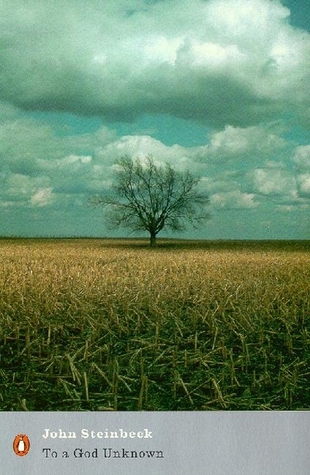
John Steinbeck: To A God Unknown

Long ago I’d expressed an interest in reading the works of John Steinbeck in chronological order, starting with Cup Of Gold, his account of Sir Henry Morgan’s piratic life, and then immediately lost track of that aim. I’ve returned to it now, albeit with a slight ‘administrative’ error, in that I’ve come next to To A God Unknown (1933), rather than The Pastures Of Heaven, published the prior year.

Year of publication aside, To A God Unknown took Steinbeck the greatest number of years of any of his works to write, so if the year of publication doesn’t precede The Pastures Of Heaven, the idea certainly does. In fact, as Robert DeMott makes clear in his lengthy introduction, the novel has its origins in an unfinished play by one of his classmates, and over the years saw many drafts and titles as Steinbeck toiled to get it under wraps. It may not be the best of the books he wrote, but it was the one that, through the toil of writing it, made him as a writer.

The novel begins on the Wayne Farm in Vermont, where Joseph Wayne expresses to his father an interest in following the westering crowds and claiming himself some land. (”If I wait, the good land might all be taken.”) where it’s preferred that he stay home a while and find a wife.

“If you could wait a year,” the old man said at last, “a year or two is nothing when you’re thirty-five. If you could wait a year, not more than two surely, then I wouldn’t mind. You’re not the oldest, Joseph, but I’ve always thought of you as the one to have the blessing. Thomas and Burton are good men, good sons, but I’ve always intended the blessing for you, so you could take my place. I don’t know why. There’s something more strong in you than in your brothers, Joseph; more sure and inward.”

In a Joseph, with brothers, singled out by his father there’s an nod to the Joseph of Genesis (no coat of many colours, though), enhanced by the skill of interpreting symbols and later incidents pertaining to the land he settles. On reaching this new pasture, verdant and teeming with life, Steinbeck foreshadows Joseph’s path and gives a first real taste of his intuitive ability:

The past, his home and all the events of his childhood were being lost, and he knew he owed them the duty of memory. This land might possess all of him if he were not careful. To combat the land a little, he thought of his father, of the calm and peace, the strength and eternal rightness of his father, and then in his thought the difference ended and he knew there was no quarrel, for his father and this new land were one. Joseph was frightened then. “He’s dead,” he whispered to himself. “My father must be dead.”

With his father indeed dead, the remainder of his brothers uproot their families to join him and together they farm this new promised land, raising cattle, breeding pigs. Joseph takes a young wife, an educated schoolteacher, and it’s all happy families for a time. Tensions rise, however, as one of the brothers, Burton, confronts Joseph on his pagan beliefs, namely his attitude toward a large tree that looms over the farmhouse:

“My father is in that tree. My father is that tree! It is silly, but I want to believe it.”

Through Joseph Wayne, almost shamanlike in his understanding of the land, we follow an exploration of man’s relationship to nature, for better and for worse. In he good days the livestock breeds, the crops grow, and the rains come; in the bad days, the opposite, and the land dries. When, knowing the harshness of the land, sticks are upped and people move to pastures new, all that remains is Wayne, stubborn to the last, which leads to a wonderfully ambiguous conclusion that leaves open a number of possible readings.

At times the abundance of description can, though evocative, be laid on thick, and the dialogue comes across as wooden, but there are still moments when Wayne reflects on the world around him that raise the book above mere catalogue of events and add a further depth to what could otherwise be a flat character:

High up on tremendous peak, towering over the ranges and the valleys, the brain of the world was set, and the eyes that looked down on the earth’s body. The brain could not understand the life on its body. It lay inert, knowing vaguely that it could shake off the life, the towns, the little houses of the fields with earthquake fury. But the brain was drowsed and the mountains lay still, and the fields were peaceful on their rounded cliff that went down to the abyss. And thus it stood a million years, unchanging and quiet, and the world-brain in its peak lay close to sleep. The world-brain sorrowed a little, for it knew that some time it would have to move, and then the life would be shaken and destroyed and the long work of tillage would be gone, and the houses in the valley would crumble. The brain was sorry, but it could change nothing.

While To A God Unknown is a minor Steinbeck, it’s important in light of the works that would come later. In its California setting, the hardship of a devastated land, and Biblical allusions we are given a dress rehearsal of major Steinbeck novels. Apparently less than six hundred copies of the novel sold on its initial release. Dress rehearsals were never meant for the public anyway.


Find out more at: Amazon UK | Amazon US | GoodReads

13 responses so far. Keep them coming. »

AddThis Social Bookmark Button

John Steinbeck: Cup Of Gold

October 14th, 2007 Stewart

Posted in swashbuckler, nautical, Penguin Classics, piracy, money, America, historical, Steinbeck, John, love

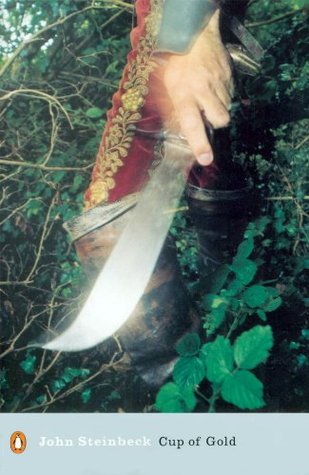
John Steinbeck: Cup Of Gold

It has been my intention, for some time now, to read (and in some cases, reread) the works of John Steinbeck. Amongst his canon there’s a varied mix of fiction, essays, and journalism and I think it would be best to read them in sequence in order to experience Steinbeck’s progression as a writer. Thus I begin with Cup Of Gold (1929), Steinbeck’s first novel, and his sole piece of historical fiction, something he would later consider “an immature experiment”. By this he meant that it was the novel that had to be written by the fledgling writer in order to purge the influence of those who had gone before.

So what we have here is a Steinbeckian swashbuckler - just over two hundred pages yet epic in feel, the scope hinted at in the novel’s subtitle: A Life Of Sir Henry Morgan, Buccaneer, With Occasional Reference To History. In Cup Of Gold, Steinbeck sets out to write a fictional account of the famous pirate’s life - from boyhood to death - and, despite its faults, he delivers.

It begins, in Wales, where the fifteen year old Henry Morgan lives on the farm with his parents. One night a former farmhand - who had left years before for the Indies - returns and tells of his adventures, the excitement of which spark young Morgan to make the decision to leave home and make his fortune overseas. While his father feels he cannot stop his boy from leaving home, his mother has a hard time letting him go, for she believes him still her little boy and, as regards his notion to become a seaman, “such matters as had so obviously no connection either with the church or with the prices of things were plainly nonsense.”

Before finalising his decision to leave for the Indies, Morgan is encouraged to talk with the local Cambrian hermit, a man who borrows the name of Merlin. After a brief conversation full of cryptic wisdom and prophcies, it is decided that Morgan could be famous, as long as he remains childish in his dreams:

“You are a little boy. You want the moon to drink from as a golden cup; and so, it is very likely that you will become a great man - if only you remain a little child. All the world’s great have been little boys who wanted the moon; running and climbing, they sometimes caught a firefly. But if one grow to a man’s mind, that mind must see that it cannot have the moon and would not want it if it could - and so, it catches no fireflies.”

And so the life of Morgan continues, first to a bar in Cardiff where his first experiences of the world at large are revealed to him in the chattering of myriad languages and “the colors of faces from beef red to wind-bitten brown.” Then, through his naivete, Morgan finds himself working his passage to the Indies only to be sold into slavery when he arrives there. But, undeterred, he works his sentence, never letting his dream of being a buccaneer fade, and in this time he grows from innocent boy to ruthless man who, as Merlin predicted, wanted the moon.

The moon, in this instance, is a woman famed for her beauty, named La Santa Roja - yet it is also Panama, the ‘Cup of Gold’ of the title. After the many skirmishes at sea that have built his reputation, Morgan sets his sights upon wresting Panama from Spanish hands and gaining untold of fortune. It’s a masterplan in tactics that sees many deaths before opposing sides even clash, due to starvation and the cruel terrain. But when the city is sacked, Morgan finally finds himself in the company of La Santa Roja, and despite all of his effortless conquests she proves to be more his match, reducing him to a man that no longer wishes the moon.

As Steinbeck novels go, Cup Of Gold is an enjoyable but average romp around the Caribbean. The language that would grace later works is certainly evident but not all characters feel fully fleshed. Dialogue, also, is a little off. But, to the novel’s credit there are sections where Steinbeck eschews the narrative to give historical asides to topics such as the rise of English presence in the Indies, marking out England as ruthless and ingenious as Morgan himself:

…felons were gathered out of the prisons, and vagrants from the streets of London; beggars who stood all day before the church doors; those suspected of witchcraft or treason or leprosy or papism; and all were sent to work the plantations under orders of indenture. It was a brilliant plan; the labor needed was supplied, and the crown actually received money for the worthless bodies of those it once fed and clothed and hanged. More could be made of this.

While it’s probably a novel for Steinbeck completists, Cup Of Gold contains elements that were forever interests to him, namely piracy and Arthurian legend. It stands well on its own and its historical context ensures that it will never truly date - although it felt more like a myth than a proper history given the tracts of dialogue characters would reel off, full of experience, knowledge, and superstition. But it’s a fine meditation on money and love and of what can be achieved when the mind is determined - a minor Steinbeck treasure worth plundering.


Find out more at: Amazon UK | Amazon US | GoodReads

1 response so far. Why not add your thoughts? »

AddThis Social Bookmark Button


sikiş izle Kuzey Güney porno oral porno porno izle porno izle film izle dizi izle porno izle geciktirici krem escort bayan google hack porno izle