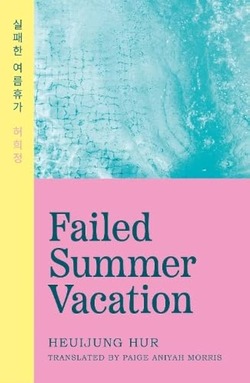
Failed Summer Vacation (2020, tr: Paige Aniyah Morris, 2025) is a curious collection of seven tales by Korean writer Heuijung Hur. From the outright speculative to the hauntingly personal, its range is interesting though the stories seem to resist interpretation. If its characters are named, we mostly know them by initials; except for one excursion to Hokkaido, the locations feel similarly elusive.
The opener, Flying in the Rain, is an outright science-fiction story that sees G tell his counsellor of a trip back to Earth. With all its talk of greenhouses, plants, and oxygen, it feels very in message, but with talk of returning to the home planet and with an Interplanetary Union, one wonders if it is also a veiled exploration of how those who escape North Korea can find themselves overwhelmed by the future shock of the South and yearn to return.
The following story, Imperfect Pitch, explores human connections over the internet. Baek hangs around on a site dedicated to the disbanded group named in the title, and finds himself drawn to the mysterious O, a superfan knowledgeable about all things related to the band. When he receives a message informing him about O’s death, he recalls the time she sold him a ticket to see them overseas and yet, even then, never got to meet her. Like Baek’s obsession with the band, his similar focus on this unknowable person stifles his real-world relationships.
Paper Cut is an absurd tale that imagines bureaucracy incarnate, and is my favourite story from the collection. A is regularly visited by a man made from paper, who swallows files and dishes out blank pages, regularly enquiring as to whether A has written his statement, whatever that is. Despite its energetic nonsense, it remains vague enough to allow for other interpretations, such as the paper man embodying writer’s block.
Two stories bear similar titles, Failed Summer Vacation and Ruined Winter Holiday. Both are less interested in the external world but take a psychological turn, heading into the minds of unnamed narrators. If the former tends to a bitter monologue, driven by claustrophobia and too much time to oneself, the latter is more concerned about addressing someone who can no longer be addressed. These stories were less engaging to me due to their self-absorbed delivery.
The remaining tales venture into the book’s more surreal moments. In Loaf Cake, the narrator’s partner, Sand, has left and while she waits, week after week, for him to return, she buys him a cake at a local cafe, which she devours slice after slice, necessitating the purchase of a new one each time. But her burgeoning relationship with the cake seller, Snow, is one thing to her and another to him. And when Sand finally returns, it just gets odd. Equally unusual is Shard, in which two-dimensional triangles fall upon the planet without explanation, in a story that also involves buying a dog and a past incident while the narrator worked as a stagehand, where watching from the sidelines, she saw the world in a different way from others.
Given how oblique these stories can be, I found myself reading them multiple times, trying to find my way in; pulling at suggested threads and chasing its phantoms. With many characters and places often out of reach, it feels like deliberately pushing away the reader with one hand yet beckoning them to read again in the hope of greater clarity. The alienation that emanates from these pages sometimes feels not just the theme but the book’s very aim. This summer vacation is an uneasy getaway, less reliant on relaxation than baggage.