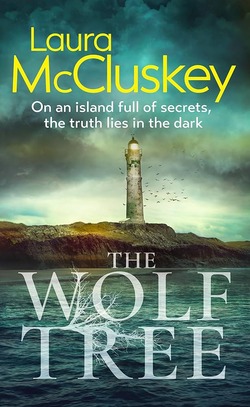
Remote Scottish islands have long been good settings for isolating people in literature. In Laura McCluskey’s debut, The Wolf Tree (2025), the two detectives who come ashore on Eilean Eadar, a fictional Hebridean island, are very much ducks out of water. The islanders, however—rooted to the island for generations—are just as secluded, albeit in a different way.
When it opens, there’s an echo of The Wicker Man (1973, dir: Robin Hardy) as its two detectives arrive by boat to find seemingly expectant locals. Unlike the film’s search for a missing person, these coppers are tasked with investigating a teenage suicide and assessing whether the cause of death might not be self-inflicted after all.
Detective Inspector Georgina Lennox—known as George—is returning to duty after being hospitalised for her gung-ho attitude to crime fighting, though she’s now hiding an addiction to opioids, a subplot that, unless expected to expand into future books, doesn’t really conclude. Acting as chaperone to his high-flying colleague is Richie Stewart, of similar rank but whose career, marked by fewer achievements, is now nearing its end. They are friends, in and out of work, but tensions also underpin their relationship.
The Wolf Tree is a police procedural, with Lennox and Richie working their way through prominent islanders in search of an elusive truth. While there’s an obvious suspicion of “mainland scum”, there’s also the menacing hint that the islanders’ reticence to speak may stem from coercion by unknown forces. Yet Eilean Eadar also harbours a historical mystery—nodding to the geographically similar Flannan Isles, where three lighthouse keepers disappeared in 1900—with Lennox invited to review, in her downtime, the surviving notebooks of this island’s missing keepers.
Despite being packaged like a thriller, McLuskey’s novel is more a slow-burn investigation shining its light into the darker recesses of island life. It nicely veers into light gothic (how could it not in such a setting?) and pleasantly hints at folk horror, with its island too remote even for the Scottish Reformation and so the old ways prevail under the cloak of Catholicism. It’s perhaps trying to do too much, taking in other genres in its central pursuit of the truth, though these genres’ atmospheric touches are greatly appreciated.
For me, the book’s biggest problem is its dialogue. It’s functional: people speak and what they say is natural in content—but so little of it feels Scottish. McLuskey, an Australian, hints at “the lyrical patterns of Gaelic” or rare moments of dialect (‘my da”; “wee barra”; “shite”). The characters rarely banter, and this flatness undercuts both the texture and realism of the setting. Perhaps this is a gripe that would only be observed by a native, but in this case it always felt at one remove from reality.
Although it doesn’t set the world (or its police) alight, The Wolf Tree is a decently plotted mystery that keeps us guessing, helped in part because its mysterious title only becomes evident toward the end. Despite reservations over its Caledonian credentials, McLuskey’s descriptive writing feels assured, although her main characters come across as less interesting than the supporting cast. If this is to be the first in a series of ongoing appearances for Lennox, then they will definitely benefit from deeper immersion in the their setting—and hopefully sharper dialogue will come from it.