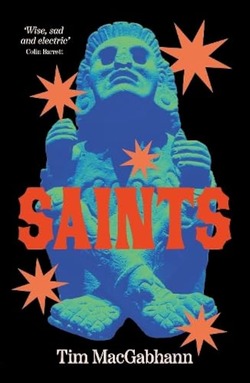
Narcotics don’t just run through the veins of the addicts in Saints (2025), but through each of Tim MacGabhann’s stories in his first collection. A former addict himself, MacGabhann’s stories carry a truth that suggests a well of lived experience and hints at art imitating life. But they also evoke his wider world: the Mexico where he once lived, depicted here as a place devastated by corruption, incompetence, and endless failure, a land where faith is the only tangible thing worth grasping.
In the opener, Chairs, the unnamed narrator prepares for an impending storm by stacking sandbags around the ground floor of the place where he runs a meeting of Narcotics Anonymous. As a recovered addict, there’s a clear drive to ensure the meeting happens, as if helping others is a new – albeit cleaner – habit. Like addiction, where the shadow of a relapse always looms, one has to prepare for the worst in order to survive. Beyond this space, there are hints of both a gentrifying Mexico City – where a hipster pulquería rubs shoulders with a grubby sex shop – and a wider continent still nursing the wounds, as charted by Eduardo Galeano’s Open Veins of Latin America (1971), of its colonial past (‘Europe is the incision through which the whole continent is bleeding to death.’).
Satellite goes deeper into institutional corruption while reckoning with the burden of guilt. Alejandro, a marine-turned-cop, travels to witness a satellite fall to earth. Events along the way trigger the unfurling of his suppressed past, which comes crashing down from the dark orbit of his mind. It’s a rather brutal story, spare in its grim details, but haunting long after its conclusion. That Juan Rulfo’s 1955 classic, Pedro Páramo, is namechecked comes as little surprise, for this is a story where the living and the dead also collide.
As the city reels from a recent earthquake in Better, we find Diego lying in his wrecked apartment, strewn with needles and booze, contemplating whether this cosmic shake was necessary for going straight. Although not the main focus of Cleaner – which follows a crime scene cleaner and callbacks to a past affair – Diego’s repeat appearance suggests this isn’t just a collection of stories, but a loose sequence. And as his cameos continue, sometimes tangential, other times prominent, it’s not hard to imagine him as MacGabhann’s literary alter-ego. As he crawls from addiction and expresses himself in new ways – following an encounter with figurines holding blank slates in Chefs – redemption seems earned rather than assured. Indeed, a person has to remain in control as addictions can never truly be conquered.
But Saints isn’t without its other damaged souls, though their stories overlap with Diego’s in interesting ways. In Beach, a woman released from prison attempts off-grid living, where she encounters an American who fled from America during a febrile 1973. And in Dive a journalist who longs to write about the gruesome details of the city’s murders instead finds value in the stories of a survivor.
Title story Saints is that of Veronica, told in first person, about two women who have lost sons. That one offers to repair a Mayan figurine for the other, poorer woman, shows their grief as a leveller over any other barrier that divides them. It’s indicative of the balance that runs through these stories, where one thing always offsets the other, whether that be the stories’ events and their metaphor, similar experiences that repel alignment, or, as in the book’s closer, Bodies, familiar siblings find a way forward through their own problems.
The nine stories in Saints, with their single-word titles, give nothing away about MacGabhann’s style. Yet there’s a certain lightness to his prose that counters its heavier content, all parcelled up in a hardboiled wrapper. Despite moments where slipping between questionable and objective realities or hopscotching through timelines warrants a double take due to abrupt shifts, the book offers a smooth ride, navigating both the lives of its people and the bruised terrain of their setting, a Mexico that is heavily corrupt and deadly, but also lightly built from the merest mentions; an Oxxo store here, a plate of chilaquiles there, a drive to Coatzacoalcos. That it doesn’t impose place with bulky detail reinforces the colonial undertone: such impositions only happen in one direction.
Though one story references The Lives of the Saints, and their painful deaths, as a religious thread through the book, the real saints of this book are in no way holy; they’re just humans making do in a rotten world. For all that life throws at them – be it addictions, loss, or mental collapse – there are opportunities for redemption. Disasters, death, and drugs may form the fabric from which these enjoyable tales are woven, but their interwoven patterns depict hope.