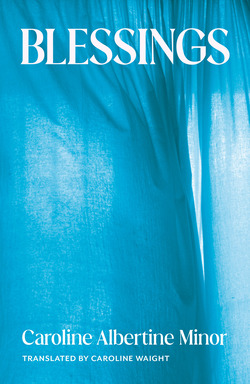
Blessings (2017, tr: Caroline Waight, 2026) is a collection of short stories by Danish writer, Caroline Albertine Minor, that explore grief and its slow burn on the lives left behind. Each is told in an undramatic way, typically recounted by a first-person narrator directly affected – and perhaps mentally adrift – with various spins on loss. Though its prose feels keenly honed and polished, the craft shows in how its carefully chosen details leave us to contemplate its larger, often unknowable, gaps.
In the opener, and longest of the stories, Villages de France, its narrator, Helene, is grieving a relationship that barely existed: her father has been absent for much of her life. Now with a debilitating illness, she travels to his home in France to reconcile, though finds the possibility of closure is unlikely on her terms. While Helene has been abandoned by her father, another story delivers a different spin on this, with Warmest, exploring a woman left holding the baby as her husband vanishes one day without explanation. And in Grief’s Garden, arguably the most devastating of the stories, another narrator deals with the loss of her husband, though this time a brain injury from a car crash means he has never physically abandoned her but the shell that remains (called M, perhaps to differentiate from who he fully was before) is not the same person she loved before, and married. All these stories, while standalone, allow Minor to demonstrate forms of grief that sit outside conventional understandings rooted in death.
But death also sits at the heart of the book, as a loose trio of stories focus on the suicide of a young au pair Down Under. That physical expanse between Australia and Denmark is echoed in the associative distance between people, no matter how close. Her name is Anne-Sophie, nicknamed Anso, and part of the book’s lingering mystery is the reason for her act. Forget Archie Pey focuses on Anso’s mother on learning the devastating news. In Flügel des Lebens, the Anso ‘trilogy’ switches to the perspective of Franciska, a childhood friend, who reveals a new view of the troubled girl, but still incomplete. Though Anso remains tangential to these stories, it’s her loss that dictates how they approach it in their own lives. The third story – and the book’s closer – Anso Has The Last Word – centres the dead girl in her own narrative, teasing more details, but bringing us no nearer a conclusive understanding. When Franciska finds a jigsaw and solves some of the edges, it’s a wonderful metaphor for the mystery of a life, with us only knowing the periphery and not the overall picture of a person.
Despite the overarching sadness of these stories, Minor makes them come alive. The smell of places is amplified by absence, which is really a psychological anchor to the missing person. Grief doesn’t halt everyday life, and the women affected in these variations on loss still find themselves having to raise children indifferent to their mothers’ sorrows (although they’ll no doubt have their own spin on this as they grow, like Helene and her estranged father). And the reactions to loss see characters turn to sex, to religion, and to ideas, with others all too eager to welcome them in, self-interested motives or not.
In Blessings, at the centre of the book, another young woman, with a child, is not grieving for her husband but for his dead friend, with whom she had an affair. When she thinks back to an initial moment of tardiness, his ‘Sorry, I’m late’, feels emotionally deeper in retrospect. But this story actually captures fleeting moments of happiness, which provides an optimistic backbone, with grief and hope sitting on an unbalanced scale, liable to tip either way. Good times can puncture the bad times, but like much of this book, they can’t resolve them. So count your blessings, as the saying goes.
The seven stories are mirrors held up to lives, reflecting only what can be seen. Beyond the edges, details are unknowable. It’s the details Minor gives us that are clues to the truth, even if the characters don’t necessarily see it themselves. Even when the stories overlap, with characters or through ideas, they are universally inconclusive, which is ultimately the book’s strength as it feels a genuine existential reflection loss whether it be mortality, abandonment, or estrangement. The many gaps this book leaves for readers are a perfect example of the losses it spends time exploring. We share in the characters’ lingering sadness without ever being able to understand their full story either.